Prime Minister Gordon Brown has told MPs that the broadcast of the assisted suicide of a terminally ill man would have to be judged by Ofcom.
Speaking in Prime Minister's Questions, Brown said he hoped broadcasters would handle such matters with
care but that programme Right to Die? , on Sky Real Lives , would be considered by Ofcom.
I think it is important that these issues are dealt with sensitively and without sensationalism and I hope broadcasters will remember that
they have a wider duty to the general public. Of course, it will be a matter from the TV watchdog when the broadcast is shown.
He was responding to Liberal Democrat MP Phil Willis who asked whether the Prime Minister regarded the programme as
being in the public interest or simply distasteful voyeurism.
Brown acknowledged there were different views about assisted dying but stated he was opposed to legislation making it lawful.
He added: I think it is necessary to
ensure there is never a case in the country where a sick or elderly person feels under pressure to agree to an assisted death or somehow feels it is the expected thing to do. That is why I have always opposed legislation for assisted death.
A documentary that appears to show the moment when a man dies after going through with an assisted suicide was strongly criticised yesterday by anti-euthanasia campaigners and Mediawatch-UK.
The film, which is being screened on the Sky Real Lives
channel tonight, seems to show the moment when 59-year-old Craig Ewert, who had motor neurone disease, died. It is believed this would be the first time the instant of the a person's death in an assisted suicide has been shown on British television.
Both the documentary maker, Oscar winner John Zaritsky, and Sky insisted that the film, Right to Die? - which is being shown at 9pm - is an important contribution to a vital debate.
Ewert, a retired university professor from Harrogate,
Yorkshire, travelled to Dignitas, the organisation in Zurich that helps people to die, because he did not want to spend the rest of his days in a living tomb.
The documentary shows Ewert and his wife, Mary, exchanging a last kiss. He says:
I love you sweetheart - so much. Have a safe journey. I will see you some time.
Ewert is then given a liquid and told he will die if he drinks it. He drinks through a pink straw, then asks for some apple juice and music. Shortly before his
eyes close, he says: Thank you.
Dr Peter Saunders, a director of the Care Not Killing alliance, branded the film macabre death voyeurism. This is taking us a little further down the slippery slope. It seems there is a macabre
fascination in this death tourism.
Dominica Roberts, of the Pro-Life Alliance, said the programme sent out the message that some people's lives are worthless , adding: It is both sad and dangerous to show this kind of thing on the
television.
John Beyer, director of Mediawatch-UK, said: This subject is something that is quite an important political issue at the moment and my anxieties are that the programme will influence public opinion.
Barbara Gibbon,
head of Sky Real Lives, said: This is an issue that more and more people are confronting and this documentary is an informative, articulate and educated insight into the decisions some people have to make. I think it's important that broadcasters give
this controversial subject a wider airing.

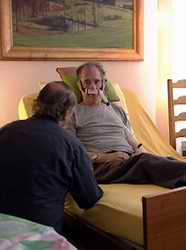 Prime Minister Gordon Brown has told MPs that the broadcast of the assisted suicide of a terminally ill man would have to be judged by Ofcom.