The Prince of Wales' 60th birthday show on ITV provided yet another opportunity for Stephen Green of Christian Voice, to indulge in a display of offended piety.
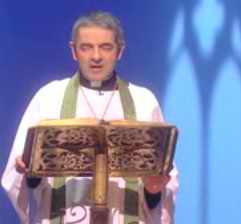
This time it was Rowan Atkinson's skit on Jesus' miracles in the Gospel of St John.
This is from a circular sent out by Green:
Rowan Atkinson mocks Christ at Prince's Birthday Show
Rowan Atkinson mocked the Bible, Jesus Christ, His miracle at Cana and His
crucifixion on the Prince of Wales' 60th birthday show at 8.35pm on Saturday 15th November 2008 which was broadcast on ITV as ‘We are most amused'.
Atkinson came on dressed as a vicar and began to read from John
Chapter 2. After half a verse he began to blaspheme the word of God and mock the Lord and His miracles as conjuring tricks.
Since the presentation did not change, it would not have been clear to someone unfamiliar with
the scriptures what was from the Bible and what was not. Atkinson finished up by saying: He did go unto Jerusalem and he did his full act … they absolutely crucified him.
Atkinson has rightly defended political
satire and his biography quotes him as saying: The freedom to criticize ideas, any ideas - even if they are sincerely held beliefs - is one of the fundamental freedoms of society.
But his sketch was not
political satire, nor did it criticise any idea or belief of Christianity. It was just insulting, mocking, crass and disrespectful. Civilised, decent people do not behave like that. Plainly Atkinson thinks there is not enough disrespect in our society
already today.
We Are Most Amused was a special comedy gala performance held to mark the sixtieth birthday of the Prince of Wales. The show included many of the UK’s leading comedians.
Ofcom received 540 complaints concerning a sketch, included in the programme, featuring Rowan Atkinson. In the sketch, Rowan Atkinson played a Christian clergyman delivering a comedic version of a biblical miracle story – the Wedding Feast at Cana.
The complainants considered the sketch to be offensive and blasphemous, and some complainants questioned whether a similar sketch would be permissible if the subject had been one of the world’s other religions, such as Islam. There was
evidence that the complaints were part of an orchestrated campaign. [Stephen Green's Christian Voice being previously noted as organising such a campaign]
Playing the clergyman, Rowan Atkinson delivered the sketch
as if reciting from the bible to a congregation. He described Jesus turning water into wine at the wedding feast at Cana, and said:
And when the steward of the feast did taste of the water from the pots, it had
become wine. And he knew not whence it had come. But the servants did know, and they applauded loudly in the kitchen. And they said unto the Lord: ‘How the hell did you do that?’ And inquired of him: ‘Do you do children’s
parties?’ And the Lord said: ‘No.’ But the servants did press him, saying: ‘Go on, give us another one’.
Further on in the sketch, Ofcom noted there were the following passages:
…and he did place a large red cloth over the carrot and then removed it. And lo, he held in his hand a white rabbit. And all were amazed, and said: ‘This guy is really good; he should turn professional’. And there
came unto him a woman called Mary…and Jesus said unto her: ‘Put on a tutu and lie down in this box’. And took he forth a saw and cleft her in twain.
…And he did go unto Jerusalem, and he did his full act before the
Scribes, and the Pharisees, and the Romans. But alas, it did not please them in their hearts. In fact they absolutely crucified him.
Ofcom considered these complaints under Rule 2.3 (material that may cause offence must be
justified by the context).
Ofcom Decision
Many complainants accused ITV of blasphemy. Ofcom is not required to determine whether the ITV committed blasphemy, but whether, in this case, the provisions of
its Code had been breached.
Comedy has a long tradition of tackling challenging and sensitive subjects, such as religion. It is important and necessary, in line with freedom of expression, that broadcasters can explore such matters. Therefore
broadcasters are free to include treatments, comedic or otherwise, of any religion, as long as they comply with the Code.
In particular, this was a comedy sketch, by a performer well-known for his depictions of clergymen in comedic situations.
The sketch was an absurd interpretation of a well-known biblical miracle story, and was not intended as a serious interpretation of Christian belief, nor would it be realistic to make such an inference.
It superimposed onto the original story, the
concept of how some people might react today, if Jesus were to appear in modern society. In making an analogy between miracles and magic, the comedian used the well-known comic device of placing theological figures in a contemporary and everyday human
situation. The overall tone of the sketch was affectionate and not abusive of the Christian religion.
Ofcom considered that the approach would have been well understood by the vast majority of the audience and would not have gone beyond what
would normally be expected in a programme of this type. Therefore, the programme was not in breach of Rule 2.3.
 The Prince of Wales' 60th birthday show on ITV provided yet another opportunity for Stephen Green of Christian Voice, to indulge in a display of offended piety.