|
|
Britain and Bangladesh start processes to censor internet porn.
|
|
|

|
30th November 2016
|
|
|
From thefinancialexpress-bd.com
|
The Bangladesh and UK governments have started a process to block pornographic websites and stop publication of offensive contents in the countries.
The Bangladesh Telecommunications Division and British Board of Film Censors have formed committees to detect and block websites that contain pornography, vulgar picture and video contents, according to a news agency report. The committees will
make a three-level technical proposal by listing such websites ad contents within a week, State Minister for Telecommunications Tarana Halim said. The process to block these will start after getting the list and proposal, she said after a meeting on
controlling offensive internet contents at the Secretariat . A director general of telecoms regulators BTRC will head the committee, which will comprise representatives from National Telecommunication Monitoring Centre (NTMC), internet service
providers (ISPs), mobile-phone operators and law-enforcing agencies. David Austin of the BBFC will spearhead UK censorship efforts. Tarana said the drive against internet pornography will continue even after blocking the listed porn websites. And
no doubt speaking for the UK too, she said: The availability of internet pornography and offensive content is creating a negative social impact on all the citizens, including the adolescents.
|
|
|
New Zealand film censors find that main 'harms' of depiction of sexual violence seem to be the perpetuation of stereotypes
|
|
|
|
|
30th November 2016
|
|
|
See full report [pdf] from classificationoffice.govt.nz
|
New Zealand film censors of the Office of Film and Literature Classification have been commissioning research on the topic of the depiction of sexual violence in entertainment media. The censors have presented their report framed in the jargon of
political correctness as follows: Teenagers think that inaccurate depictions or misrepresentations of sexual violence in entertainment media are potentially harmful. Harms identified included normalisation, perpetuation of
harmful stereotypes, negative impacts on victim/survivors, and being negatively influenced by behaviour seen on screen. These are some of the findings detailed in Young New Zealanders Viewing Sexual Violence, the latest research
report from the Office of Film and Literature Classification. Given that there is real concern in New Zealand about sexual violence in wider society, it is perhaps surprising that to-date there had been no New Zealand research
asking young people about their views of sexual violence in entertainment media such as movies, TV shows and games. The report is based on focus groups conducted with teenagers from Auckland and Wellington, undertaken by Colmar
Brunton. It represents the first part of a research and consultation project exploring the effects -- particularly on young people -- of viewing sexual violence in entertainment media. The project also explores the impact on the wider community, and
builds on international research showing that repeated exposure to violent entertainment content can have significant negative effects on young people. Project leader Lexie Kirkconnell-Kawana says that the findings will inform the
classification of sexual violence depictions in New Zealand: We hope the results of our own research translate into meaningful policy and action to improve the lives of New Zealanders, particularly in how they engage
with entertainment media. We also hope the results encourage future (much needed) research on this subject both nationally and internationally. The results so far suggest that it is not a question of if depictions of sexual
violence are shaping young people's understandings of sexual violence, but how they are shaping young people's understandings.
Chief Censor Andrew Jack says some of the findings are hardly surprising:
We know that the development of children and young people is heavily influenced by their environment and the modern reality is that media is a large part of their environment. The research shows that young
people want more and better information rather than less when making viewing choices. The wider project involves specialists in the field of sexual violence prevention, treatment and education (including front-line victim/survivor
counsellors) and academics and officials with expertise in sexual violence. Preliminary findings reveal a high degree of concern about the nature of entertainment content being made available in New Zealand, and participants agreed that young people's
unfettered access to material was a pressing issue in the provision of their services. A full report on these consultations will be published in due course.
|
|
|
Russia is getting Chinese help to censor its internet
|
|
|
|
|
30th November 2016
|
|
|
See article from businessinsider.com
|
Russia wants to step up its ability to censor the Internet, and it's turning to China for help. China's Great Firewall is the envy of the Putin regime. The Russian government recently passed a series of measures known as Yarovaya's laws
that require local telecom companies to store all users' data for six months, and hang on to metadata for three years. And if the authorities ask, companies must provide keys to unlock encrypted communications. There has been some skepticism as to
whether such laws would -- or even could -- be enforced but earlier this month Russia's internet censor, Roskomnadzor, blocked all public access to LinkedIn. What's more, it is now clear that Russia has been working with authorities in charge of
censoring the Internet in China to import some aspects of the Great Firewall that have made it so successful. According to the Guardian , the two countries have been in close talks for some time, and the Chinese digital equipment maker Huawei has
been enlisted to help Russian telecom companies build the capacity necessary to comply with Yarovaya's laws.
|
|
|
|
|
|
|
|
30th November 2016
|
|
|
The PC lynch mob takes aim at TV presenter. By Brendan O'Neill See article from blogs.spectator.co.uk
|
|
|
A rare occurrence these days, politicians that are standing up for the rights of the people
|
|
|
|
|
29th November 2016
|
|
|
See article from theregister.co.uk
|
The Liberal Democrats are to oppose plans to censor internet porn sites in the name of 'protecting the children'. Brian Paddick, Liberal Democrat Shadow Home Secretary, said: Liberal Democrats will do everything possible
to ensure that our privacy is not further eroded by this Tory government. Clamping down on perfectly legal material is something we would expect from the Russian or Chinese governments, not our own. Of course the internet cannot
be an ungoverned space, but banning legal material for consenting adults is not the right approach.
The Internet Service Provider Association has also said moves to force providers to block adult sites that do not age verify has the
potential to significantly harm the digital economy . ISPA chair James Blessing said: The Digital Economy Bill is all about ensuing the UK continues to be a digital world leader, including in relation to
internet safety. This is why ISPA supported the government's original age verification policy for addressing the problem of underage access of adult sites at source. Instead of rushing through this significant policy change, we
are calling on government to pause and have a substantive discussion on how any legal and regulatory change will impact the UK's dynamic digital economy and the expectations and rights of UK Internet users.
|
|
|
Gareth Johnson, Britain awards you the Britisher's Cross, for distinguished ineptitude in legislative service
|
|
|
|
|
29th November 2016
|
|
|
See article from bbc.com
See The Britisher on the subject
from YouTube
|
A ludicrous Private Member's Bill making it offence for people to wear military medals to which they are not entitled has been backed by the government. The Awards for Valour (Protection) Bill tabled by Conservative MP Gareth Johnson passed its
Commons second reading on Friday. It could create a new criminal offence with a maximum penalty of six months' imprisonment or a £5,000 fine. Defence Secretary Michael Fallon says he fully supports the proposal. It is so
typical of our disgraceful politicians, to propose extreme punishments for trivial reasons so that they can feel good about some pet peeve of theirs. James Glancy, a former captain in the Royal Marines who received the Conspicuous Gallantry Cross
for his service in Afghanistan, told the BBC's Daily Politics the bill goes too far . He commented: I think it's just going too far to suggest someone could go to prison. I think it's very important to look at
what's going on with someone that is actually pretending that they served in the armed forces. There may well be a serious mental health problem and actually that person just has low self-esteem, they're not a threat to the public, and they actually need
professional help.
|
|
|
|
|
|
|
|
29th November 2016
|
|
|
Jodie Ginsberg, CEO of Index on Censorship spoke at the 30th anniversary of the Rafto Forum See article from
indexoncensorship.org
|
|
|
Ofcom censors Fox News for political bias
|
|
|
|
|
28th November 2016
|
|
|
See Complaints bulletin [pdf] from ofcom.org.uk
See
Ofcom mustn’t shield us from Hannity we need to see the full horror from theguardian.com
|
Hannity
Fox News, 2, 5 and 6 August 2016, 03:00 Fox News is a news channel originating in the USA, broadcast on the digital satellite platform and licensed by Ofcom in the UK. Hannity is a live current
affairs programme, presented by Sean Hannity, that discusses and analyses political and news stories. During routine monitoring, Ofcom identified three one hour programmes which were broadcast in the US at 22:00 Eastern Standard
Time and simultaneously in the UK at 03:00. The programmes included a number of statements relating to the 2016 US Presidential election. Our concern in this case was whether these three programmes were duly impartial in their coverage of the US
Presidential election campaign. Ofcom then cited pages of examples of pro Trump bias eg the following exchange in an interview with Trump: Khizr Khan, a US citizen of Pakistani origin received widespread media
attention for criticising Donald Trump at the 2016 Democratic National Convention. Hannity : When you talk about refugees, illegal immigration, you're not talking about people like the Khans. For example, James Clapper, our
National Director of Intelligence, our CIA Director, or FBI Director, Assistant FBI Director, our Chairman of the House Homeland Security Committee, and even General John Allen, Obama's special envoy to defeat ISIS: They have all warned us that the
refugees that Obama's taking in -- and Hillary wants a 550% increase -- that refugee population will be infiltrated. Are you clear you are not talking about the Khans, you're talking about what these people are saying? Trump
: No, I'm not talking about the Khans, I'm not talking about a lot of people. I'm talking about people coming over here from Syria that aren't properly vetted, their immigration, nobody knows if they're ISIS, they don't know who they are. They're
being put all over the country. Hillary wants a 550% increase over what Obama's bringing in. Obama's bringing them in by the thousands, by the thousands, and she wants to bring them in 550% more. I think it's insane. Now I also think that what we should
do is build safe zones over in Syria, have the Gulf states pay for it. They've got plenty of money. They're not doing their job right nowâ?¦We have to get back to rebuilding our country, rebuild our infrastructure, create jobs, take jobs away from Mexico
and all these countries that are taking our jobs.
Ofcom considered Rule 6.1: The rules in Section Five, in particular the rules relating to matters of major political or industrial
controversy and major matters relating to current public policy, apply to the coverage of elections and referendums.
And the section 5 rules considered were: Rule 5.11: In addition
to the rules above, due impartiality must be preserved on matters of major political and industrial controversy and major matters relating to current public policy by the person providing a service (listed above) in each programme or in clearly linked
and timely programmes. Rule 5.12: In dealing with matters of major political and industrial controversy and major matters relating to current public policy an appropriately wide range of significant views must be included and
given due weight in each programme or in clearly linked and timely programmes. Views and facts must not be misrepresented.
Ofcom then spent several more pages analysing the bleedin' obvious, that Hannity (and Fox News in general) were
heavily biased in favour of Trump. Ofcom concluded: In these programmes, we considered that there were a large number of positive viewpoints expressed about Mr Trump and his campaign, coupled with the fact that Hillary Clinton and
her candidacy were strongly criticised. As already mentioned above, this meant that there was an overwhelmingly one-sided view on a matter of major political controversy and major matter relating to current public policy, i.e. the policies and actions of
the two principal candidates contesting the 2016 US Presidential Election. For the reasons set out above, our Decision was that this material had clearly breached Rule 6.1 (and Rules 5.11 and 5.12).
|
|
|
Government selects the BBFC as the internet porn censor
|
|
|
|
|
27th November 2016
|
|
|
See press release from bbfc.co.uk
See
Letter of Understanding [pdf] from bbfc.co.uk
|
The BBFC has issued the following press release:
Digital Economy Bill Age Verification Letters of Understanding On 06 October 2016, the BBFC exchanged letters of understanding with DCMS confirming DCMS's intention, in principle, to appoint the BBFC to take on a
regulatory role in the age verification of pornographic content online, as proposed in the Digital Economy Bill. These letters are available below. The Digital Economy Bill contains measures to establish the same standard of
protection online as currently exists offline with the aim of reducing the risk of children and young people accessing, or stumbling across, pornographic content online. The BBFC's proposed role in the age verification of
pornographic content online, as laid out in the Digital Economy Bill, is subject to designation by both Houses of Parliament.
The Letter of Understanding form Baroness Shelds of the DCMS to David Austin reads:
I would like to drank you for the British Board of Film Classification's continuous help and support in developing the Government's manifesto commitment to Introduce Age Verification (AV) checks for online pornography. As you
know, the AV clauses contained in the Digital Economy Bill have been designed to ensure that pornographic material must not normally be accessible online to users in the UK on a commercial basis without appropriate age verification checks. We appreciate
BBFC's ongoing support especially in helping develop effective options for Stages 1-3 of the proposed regulatory framework. I understand you have worked with my officials in thinking through these proposals and had a productive meeting on 16 September to
discuss your role in more detail. We are committed to this policy and aim to introduce an effective regulatory framework to enable its smooth delivery. BBFC's experience in making effective editorial judgements Is important to the
success of the policy. I would like to invite the BBFC to take on a regulatory role within the proposed framework, subject to the particulars of the proposed designation being laid in both Houses of Parliament. In working together, it is our intention
that:
Both DCMS and the BBFC are committed to working openly and transparently to establish an effective regulatory framework for the age verification of pornographic content online; That the BBFC will
create a proportionate, accountable, independent and expert regulatory function, that would seek among its alms to promote voluntary compliance and advise Her Majesty's Government (HMG) mars widely on reducing the risk of pornography being made readily
available to children; That the BBFC will be responsible for Stages 1-3 of the proposed regulatory framework and that any enforcement function under the current Bill Clauses 20 and 21 will be carried out by another regulator
that will have equal status to the BBFC, DCMS will fund the BBFC's start up, and those already incurred. subject to final agreement once legislative approvals are in place.
Please note, this letter Is nonbinding and constitutes an indication of intent rather than creating a liability or obligation of any nature whatsoever to DCMS or the BBFC. I look forward to heating from you
very soon and would like to thank you once again for your valuable contribution and ongoing co-operation.
|
|
|
Blasphemy cuts waived to John Waters' Multiple Maniacs
|
|
|
|
|
27th November 2016
|
|
|
|
|
Multiple Maniacs is a 1970 USA crime comedy horror by John Waters.
Starring Divine, David Lochary and Mary Vivian Pearce.


UK: Passed 18 uncut for strong sex references, sexual violence with previous BBFC cuts waived for:
UK Censorship History Heavily cut by the BBFC on grounds of blasphemy for 1990 18 rated VHS. A restored version was passed 18 uncut with previous cuts waived for 2016 cinema release. The previous BBFC cuts were:
- Cut to remove an entire supposedly blasphemous sequence set in a church in which a male transvestite buggered himself with a rosary. The shots of the transvestite were intercut with footage of Christ moving through the Stations of the
Cross.
Summary Notes The travelling sideshow 'Lady Divine's Cavalcade of Perversions' is actually a front for a group of psychotic kidnappers, with Lady Divine herself the most vicious and depraved of all -
but her life changes after she gets raped by a fifteen-foot lobster...
|
|
|
|
|
|
|
|
27th November 2016
|
|
|
Discussing the reasons why the rating for Diamonds are Forever increased from PG to 12 See product details at amazon.co.uk
|
|
|
|
|
|
|
|
27th November 2016
|
|
|
The BBFC is famous for enforcing bizarre notions about what can be depicted in film, based on outdated laws surrounding obscenity See
article from vice.com
|
|
|
So who will be watching over your shoulder as you surf the internet
|
|
|
|
|
26th November 2016
|
|
|
See article from dailymail.co.uk
|
The police, NHS and the tax man will now be able to hack into your phones and check your browsing history after the Snoopers' Charter was passed by Parliament last week. The bill, officially called the Investigatory Powers Bill, forces
electronic data to be stored by internet providers for 12 months, which can be subsequently collected by law enforcement. Now a blogger has created a list of all the people who will be able to request to view your internet history. And the
snoopers are...
- Metropolitan police force
- City of London police force
- Police forces maintained under section 2 of the Police Act 1996
- Police Service of Scotland
- Police Service of Northern Ireland
- British Transport Police
- Ministry of Defence Police
- Royal Navy Police
- Royal Military Police
- Royal Air Force Police
- Security Service
- Secret Intelligence Service
- GCHQ
- Ministry of Defence
- Department of
Health
- Home Office
- Ministry of Justice
- National Crime Agency
- HM Revenue & Customs
- Department for Transport
- Department for Work and Pensions
- NHS trusts and foundation trusts in England that
provide ambulance services
- Common Services Agency for the Scottish Health Service
- Competition and Markets Authority
- Criminal Cases Review Commission
- Department for Communities in Northern Ireland
- Department
for the Economy in Northern Ireland
- Department of Justice in Northern Ireland
- Financial Conduct Authority
- Fire and rescue authorities under the Fire and Rescue Services Act 2004
- Food Standards Agency
- Food
Standards Scotland
- Gambling Commission
- Gangmasters and Labour Abuse Authority
- Health and Safety Executive
- Independent Police Complaints Commissioner
- Information Commissioner
- NHS Business Services
Authority
- Northern Ireland Ambulance Service Health and Social Care Trust
- Northern Ireland Fire and Rescue Service Board
- Northern Ireland Health and Social Care Regional Business Services Organisation
- Office of
Communications
- Office of the Police Ombudsman for Northern Ireland
- Police Investigations and Review Commissioner
- Scottish Ambulance Service Board
- Scottish Criminal Cases Review Commission
- Serious Fraud Office
- Welsh Ambulance Services National Health Service Trust
|
|
|
|
|
|
|
|
26th November 2016
|
|
|
Porn Censorship in Britain 2016: The Digital Economy Bill. By the Britisher See video from YouTube
|
|
|
Ofcom walk on PC eggshells to humour complainants about a Coronation Street pun on Alex Hailey's Roots
|
|
|
|
|
23rd November 2016
|
|
|
See article [pdf] from ofcom.org.uk
|
Coronation Street ITV,
29 August 2016, 19:30 Coronation Street is a long-running and well-established soap opera on ITV. Ofcom received 473 complaints about a comment by the character Eva Price
during a scene in the local hair salon. Looking at her dyed hair, she said: Yeah, look [pointing at her hair] I've got more roots than Kunte Kinte. No idea who that is by the way, it's summat my mum used to say.
Kunte Kinte is the lead character in Alex Haley's 1976 novel Roots: The Saga of an American Family which was later adapted into a popular television series called Roots. The story chronicles the life of an 18th
century African man who was captured and sold into slavery in the United States. The complainants considered the play on the word roots was unacceptable as the basis for a joke given the subject matter of the Alex Haley
story, and therefore felt that the comment was racially offensive. Ofcom considered Rule 2.3 of the Code: In applying generally accepted standards broadcasters must ensure that material which
may cause offence is justified by the contextâ?¦ Such material may include, but is not limited to... discriminatory treatment or language (for example on the grounds of...race...). Appropriate information should also be broadcast where it would assist in
avoiding or minimising offence.
Ofcom Decision: Not in breach Ofcom first considered whether the comment in this particular scene had the potential to cause offence. Slavery and ethnicity are
subjects that broadcasters should approach with due caution, especially when they are referred to in a light-hearted context which could result in sensitivities being heightened. In Ofcom's view, viewers who were aware of the Alex Haley story or the
Roots series would have been likely to associate Eva's reference to Kunte Kinte with the story, and with slavery. In the light-hearted context in which the remark was made, we considered that this reference to slavery had the potential to offend viewers.
Ofcom went on to consider if the broadcast of the material was justified by the context. Eva Price's comment was a play on the word roots , which referred to both the colour of her hair at its roots
and, through the reference to Kunte Kinte, the title of the 1970s television series. Although the series is well known for depicting the African slave trade in 18th century America, we noted that Eva's comment did not mention this at all. She only
referred to the title of the television series and name of its lead character. We took into account, in particular, that at no point was language broadcast which referred directly to ethnicity or slavery, or in Ofcom's view, was derogatory or
discriminatory. Ofcom also took into account Eva's subsequent remark that she did not understand who Kunte Kinte was, and that she was repeating the phrase because it was something her mother used to say. This reflected the
foolishness, and lack of sensitivity and cultural awareness, of her character. For her to speak in this thoughtless fashion without understanding what she was referring to, or that it might cause offence, was likely to have been consistent with the
audience's expectations of her character. We acknowledged that relatively high number of viewers complained to Ofcom, and that some viewers clearly felt very strongly about the remarks in this case. We noted the measures taken by
ITV to mitigate the potential offence to these viewers by: writing to all complainants who contacted it directly, making a public statement to the press apologising if the remark had caused any unintended offence, and removing the phrase from subsequent
broadcasts of the episode. Having taking into account all the above factors, we were of the view that this potentially offensive material was justified by the context. Therefore, the material was not in breach of Rule 2.3 of the
Code.
|
|
|
Website blocking will open up age verification to credit card fraud
|
|
|
|
|
23rd November 2016
|
|
|
See article from openrightsgroup.org
|
When you legislate at break-neck speed, and fail to consult, things will go wrong. This is absolutely the case with Age Verification (AV) in the Digital Economy Bill, which now seems set to include website blocking to bolster use of AV technologies.
This is likely to lead to high risks of credit card fraud and privacy abuse. Currently the BBFC are pinning their hopes on being able to specify some kind of privacy and safety standard through their ability to regulate arrangements
that deliver age verified material. Sites must deliver pornographic material: in a way that secures that, at any given time, the material is not normally accessible by persons under the age of 18
The regulator can issue then guidance for: types of arrangements for making pornographic material available that the regulator will treat as complying
The claim
is that this mechanism allows the guidance to specify what kind of AV is private and secure. However, if the BBFC are told to block non-compliant websites, in practice they will have to accept any system that websites use
that verifies age. To do otherwise would be highly unfair: why should a site with legal material, that uses their own AV system, end up blocked by the BBFC? This will especially apply to systems that require registration / credit
card tests. There are plenty of paysites already of course. These are not privacy friendly, as they strongly identify the user to the website - and they have to do this to minimise fraudulent payment card transactions. That's alright as a matter of
choice of course, but dangerous when it is done purely as a means of age verification. If asking for credit card details becomes common or permissible, and a credible ask in the minds of UK citizens, then the government will have
created a gold mine for criminals to operate scam porn sites targeted at the UK, inviting people to supply their credit cards to scam sites for Age Verification . In fact you could see this being extended to all manner of sites that a criminal
could claim were blocked until you prove you're over 18 . verified by visa fraud Once credit card details are harvested, in return for some minimal/copyright infringing porn access at a scam
porn site, then criminals can of course resell them for fraud. Another easy to understand example of a criminal abusing this system is that you could see criminals typo-squatting on relevant domain names such as youporm.com and asking for a credit card
to gain access. Anything that normalises the entry of credit card details into pages where the user isn't making a payment will increase the fraudulent use of such cards. And if a website is validating credit cards to prove age, but not verifying them,
then the internationally agreed standards to protect credit card data are unlikely to apply to them. Website blocking makes these scams more likely because the BBFC is likely to have to sacrifice control of the AV systems that are
permissible, and a diversity of AV systems makes it hard for users to understand what is safe to do. During the committee stage of the Digital Economy Bill, we argued that the AV regulator should be highly specific about the privacy and anonymity
protections, alongside the cyber security consequences. We argued for a single system with perhaps multiple providers, that would be verifiable and trusted. The government on the other hand believes that market-led solutions should be allowed to
proliferate. This makes it hard for users to know which are safe or genuine. If website blocking becomes part of the enforcement armoury, then websites that employ unsafe but effective, or novel and unknown, AV systems will be
able to argue that they should not be blocked. The BBFC is likely to have to err on the side of caution - it would be an extreme step to block an age-verifying website just because it hadn't employed an approved system. The
amount of website blocking that takes place will add to the scamming problem and open up new opportunities for innovative criminals. The BBFC seems to be set to have an administrative power to order ISPs to block. If this is the case, the policy
would appear to be designed to block many websites, rather than a small number. The more blocking of sites that users encounter, the more they will get used to the idea that age verification is in use for pornography or anything that could possibly be
perceived as age-restricted, and therefore trust the systems they are presented with. If this system is not always the same, but varies wildly, then there are plenty of opportunities for scams and criminal compromise of poorly-run Age Verification
systems. Security and privacy problems can be minimised, but are very, very hard to avoid if the government goes down the website blocking route. What MPs need to know right now is that they are moving too fast to predict the
scale of the problems they are opening up.
|
|
|
UK Government orders the censorship of an alt-right old boy speaking to pupils at school
|
|
|
|
|
23rd November 2016
|
|
|
See article from theguardian.com
|
A Kent school has censored a talk by Milo Yiannopoulos, a former pupil, an outspoken Donald Trump supporter, and member of the so-called alt-right movement. The censorship was apparently ordered by the Department for Education Simon Langton
grammar school for boys, which Yiannopoulos attended, said it had pulled his address to sixth-formers due to take place on Tuesday. Yiannopoulos is a senior editor at the US-based Breitbart website, whose chief executive, Steven Bannon , is Trump's
choice for chief strategist. The Canterbury school claimed the talk had been cancelled because of safety concerns, with almost all of the opposition to it coming from outside the school. The alt-right may be a bit controversial but this
hasn't really lead to any incidents of unrest so far. Anyway the school said: The decision was taken following contact from the DfE counter-extremism unit, the threat of demonstrations at the school by organised groups
and members of the public, and our overall concerns for the security of the school site and the safety of our community.
Yiannopoulos, who was permanently suspended from Twitter in July , describes himself as the most fabulous
supervillain on the internet on his Facebook page, where he added: My old high school has been bullied into cancelling my talk on Tuesday by the counter-extremism unit at the UK Department of Education.
Who even knew the DoE had a counter-extremism unit? And that it wasn't set up to combat terrorism but rather to punish gays with the wrong opinions?
|
|
|
Pakistan's TV censor bans 11 christian channels
|
|
|
|
|
23rd November 2016
|
|
|
See article from tribune.com.pk
|
TV censors of the Pakistan Media Regulatory Authority (Pemra) have banned at least 11 Christian TV channels being run across the country. The channels which have been blocked are Isaac TV, Gawahi TV, God Bless TV, Barkat TV, Praise TV, Zindagi TV,
Shine TV, Jesus TV (Jessi TV), Healing TV, Khushkhabari TV, and Catholic TV , sources said. All the channels relayed religious programmes for Christians living in the country. Pemra claimed the censorship was because the banned channels were
broadcasting without licences but that was probably down to christian channels not being allowed to have licenses. These TV channels are banned in line with ongoing Pemra campaign to ban illegal channels, Sheikh Tahir, the regulator's
general manager media, told The Express Tribune . He said the blocked TV channels did not have licences to continue their transmissions. Pemra seeks ministry's help in enforcing Indian DTH ban In response to a question that why only
Christian TV channels were banned, Sheikh Tahir, the Pemra's general manager medias claimed there was no segregation in the name of religion. Talking to The Express Tribune , Nadim Anthony, a Christian advocate and rights activist, termed it a
blow to the Christian minority of the country. Anthony said the blocked channels had a huge viewership, through which community members took religious guidance. He added: There are so many Islamic TV channels
functioning in the country but no one can dare ban them, which is discrimination.
|
|
|
The FBI is decreeded additional powers to hack the devices of computer users hiding their location using Tor, VPNs or anonymisers
|
|
|
|
|
23rd November 2016
|
|
|
See article from theregister.co.uk
|
Unless someone makes a challenge in Congress, new enhance snooping powers have been decreed for the US authorities. Extra spying powers are set to be granted by Congressional inaction over an update to Rule 41 of the Federal Rules of Criminal
Procedure. These changes will kick in on December 1. The rule tweak, which was cleared by the Supreme Court in April, will allow the FBI to apply for a warrant to a nearby US judge to hack any suspect that's using Tor, a VPN, or some other
anonymizing software to hide their whereabouts, in order to find the target's true location. Normally, if agents want to hack a PC, they have to ask a judge for a warrant in the jurisdiction where the machine is located. This is tricky if the
location is obscured by technology. With the changes to Rule 41 in place, investigators can get a warrant from any handy judge to deploy malware to find out where the suspect is based -- which could be anywhere in America or the world. The rule
change also allows the authorities to just obtain one warrant in case that cross multiple jurisdictions.
|
|
|
|
|
|
|
|
23rd November 2016
|
|
|
The BBC makes a few suggestions for not falling prey to the Snooper's Charter See article from bbc.com
|
|
|
|
|
|
|
|
23rd November 2016
|
|
|
New York Times advocates internet censorship of supposed 'fake' news See article from
commondreams.org
|
|
|
...Ofcom has added its voice to the lynch mob of censors whingeing at a joke about the Queen
|
|
|
|
|
22nd November 2016
|
|
|
Thanks to Nick
See Complaints Bulletin [pdf] from ofcom.org.uk
|
Don't Make Me Laugh
BBC Radio 4, 21 April 2016, 18:30 Don't Make Me Laugh is a comedy show, hosted by David Baddiel. A panel of comedians taking part in the programme are asked to talk about why a subject is not funny, without
making the audience laugh. If the audience does laugh, the subject passes to the next contestant. Ofcom received 12 complaints about the episode broadcast on 21 April 2016 which featured a discussion about the Queen and sex.
Complainants considered that references to the Queen in the programme were offensive and inappropriate. A number of complaints referred to the fact that the programme was broadcast on the Queen's 90th birthday. The panel of
comedians on this programme were Russell Kane, Sara Pascoe, Omid Djalili, and Adam Hess. Round two of the show was introduced by David Baddiel: In an effort to demonstrate just how grown up
and sophisticated we've become, I would like you Russell Kane to tell us why there is nothing funny about the fact that Announcer: the Queen must have had sex at least four times [laughter from the studio audience].
The panel of comedians responded by making a number of personal comments about Prince Philip and the Queen. For example, Russell Kane said the following: Four times we have to think of
republicanism as we imagine four children emerging from Her Majesty's vulva and for me [audience laughter].
Ofcom considered its Rule 2.3: In applying generally accepted
standards broadcasters must ensure that material which may cause offence is justified by the context.
Ofcom Decision: Breach of rule 2.3 Throughout this segment of the programme, the panel
made a number of comments about the Queen in an effort to explain why the subject of that round of the programme was not funny. We considered that comments about the Queen and the Duke of Edinburgh were made in a mocking way, which would have been
perceived by many listeners as humiliating and intrusive. Ofcom took into account that the Queen and the Duke of Edinburgh are public figures with wide exposure in the media. Nonetheless, we considered that the mocking and demeaning tone of these
comments made them capable of causing offence. The potential for offence was increased by the fact that these remarks were broadcast on the Queen's 90th birthday. Ofcom took into account that audiences expect some comedy
programming to be challenging and to push at boundaries. However, the reaction of the audience to comedy material is subjective and can vary widely. In this case, the jokes about the Queen were made in a way that was mocking and demeaning. The fact that
these jokes were made on her 90th birthday, in Ofcom's view, would have considerably increased the level of offence for many listeners. Furthermore, the level of potential offence was also increased to some extent by the fact this programme was
pre-recorded, so that the BBC's editorial decision to broadcast this content on this day was likely to have been perceived by listeners as deliberate and not the result of for example an inadvertent misjudgement made during a live programme.
In Ofcom's view, it is likely that Radio 4 listeners would not have expected comedic content about the Queen of this strength and directness to be included in a Radio 4 comedy programme broadcast in the early evening on her 90th
birthday. We considered also that, for all these reasons, any listeners who had come across this content unawares may well have been surprised and disconcerted to hear it broadcast on Radio 4 at this time, on the Queen's 90th
birthday. The broadcast of this potentially offensive material was not justified by the context, and there was a breach of Rule 2.3 of the Code.
|
|
|
The Digital Economy Bill is primarily reprehensible for introducing mass internet censorship, but don't forget it also enables the rapid sharing of government databases to more or less any official who makes a request
|
|
|
|
|
22nd November 2016
|
|
|
See bigbrotherwatch.org.uk
|
So what is wrong with the Digital Economy Bill?
Well, Part 5 of the Bill will fundamentally change the way our personal information is handled, shared and controlled whenever we hand it over to government.
That means that whenever we
file a tax return, apply for a driving licence, register a birth, death or marriage, apply for benefits or deal with a council, court or other public authority, all of the data we share, we will have no control of. Because if Part
5 of the Bill becomes law:
As soon as you share anything with the government, you will be blocked from having any further control over how your personal information and sensitive data is shared around government, with councils, other government bodies and
business. You will not be allowed to change your data if there is a mistake or error. You will not be asked permission or informed if an official shares, uses or looks at your data. -
You will not be allowed to opt out of your data being shared. Your birth, death, marriage and civil registration documents will be shared in bulk without your consent.
Data sharing is a fact of life and a great deal of good can come from the sharing of data, but as soon as our data is digitised it is insecure and open to exploitation.
We see this every time we read of a big company suffering
a data breach or data hack. And government aren't immune, in 2014/15 government experienced 9,000 data breaches possibly down to poor data sharing practice, certainly down to not understanding data protection laws.
Our data is us -- it is
who we are, what we do, how we live and who we know. If we don't know where it is going, who it is shared with, why it is used and what we can do to control access to it, the future of all our personal information is at risk. If
you are worried please write to your MP this week and tell them, because without challenge this Bill will pass and control of our personal information will be lost to Government forever. See how to help at
bigbrotherwatch.org.uk
|
|
|
|
|
|
|
|
22nd November 2016
|
|
|
BBFC increases its fees by 1%. I wonder how much the new internet censorship regime will cost? See article
from bbfc.co.uk
|
|
|
Reasons why the government's plan 'to protect children online' is not just dreadful but extremely alarming.
|
|
|
|
|
21st November 2016
|
|
|
From a Melon Farmers reader
|
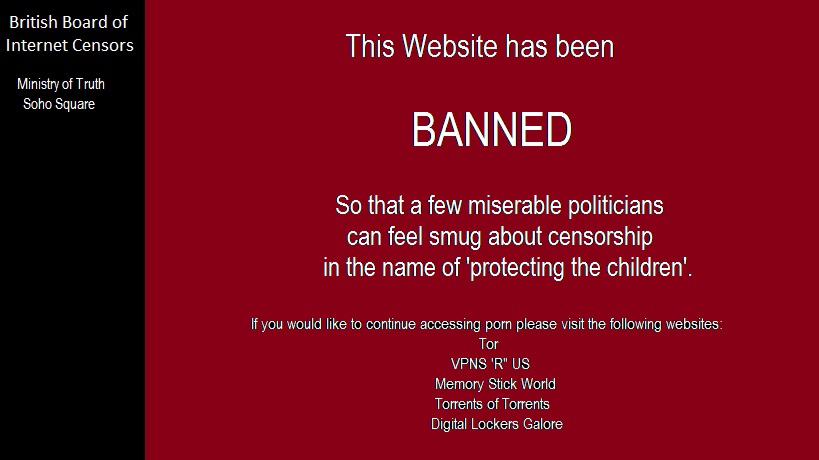
It's already been announced that the government are to press ahead with their controversial plans to create a huge database of the all the activities of every internet user in the UK . Every time you visit any website, the time and date and the name of the website will be recorded. There are no exemptions.
Such a system of blanket surveillance has not been used or proposed in any other country. You might think then, that after such an announcement, they would have been a little muted for a short
while in proposing yet more heavy handed legislation aimed at the internet. Not a bit of it. Now they really seem to have the bit between their teeth and are charging full steam ahead with, if possible, even more draconian powers.
In the 1980's, as a result of the backlash against video nasties , the government handed complete censorship of all video media to the British Board of Film Censors, now renamed the British Board of Film Classification (because they don't like to
be thought of as censors). A bit like the ministry of propaganda preferred to be called the Ministry of Truth in George Orwell's 1984. Appropriately enough, this bill was made law in 1984. Now, the latest proposal is to
effectively hand censorship of the entire internet over to the same people! The argument is that if a website which is unsuitable for children does not have adequate checks in place to verify the users age, the BBFC
will be able to block it. This might sound reasonable in theory but in practice it will culminate in a monstrous invasion of internet freedom and dangers for internet users. Here's why:
Most people know that such controls can be effectively by-passed with use of a proxy servers, or on a phone or tablet a simple app which redirects internet traffic through a secure unfiltered connection. The problem with this is
that it introduces a whole new level of risk and exposure to criminality. Traffic can be routed, without the user knowing, via servers which are known to contain criminal content thus giving the appearance that the user has been accessing child
pornography, terrorist information or other material which could incriminate them. Amongst the honest firms who run proxy servers there are con-men and criminals waiting to catch the unwary. Ransom demands and other
criminal activity is often the actual business which is sitting behind a link for what appears to be a proxy server. If you don't believe me, please do your own research. Identification will be a nightmare. Making porn or
other websites take credit or debit card details as a check of age is preposterous. Very few people would want to trust giving their credit or debit card details to a website just to even see what is on it. It's even been
suggested that these websites could cross check the UK electoral roll. How's that supposed to work? Presumably not so anybody can give the name and address of someone they dislike and that goes down on the government's list of names and addresses of
people who've visited dodgy websites? The BBFC can not just censor but entirely block any web site that contains anything they disagree with! For example if the site contains anything which they would not allow in a BBFC
certificated video. They would argue that it was their duty . Since a website containing any nudity at all, or discussion of sex, or any other thing which is not suitable for children , should be behind an age protected barrier, this will
allow them to block any web site they wish. If a site with discussion about something which is not suitable for a small child, say in the US or Canada, cannot be bothered to deal with the BBFC, it can simply be blocked completely in the UK if the owners
do not cravenly submit to the demands of a government censor in another country! Not that the websites will probably care, having written off internet users in the UK the same way as they would people who are blocked from access by any other dictatorial
government around the world. In addition to websites being blocked, if a server contains a small amount of anything which is unsuitable for children, the domain itself, containing many other web sites, can be blocked. Because
most countries in the world are more broad minded and less adamant about state control of what people see than the UK, nobody else will have noticed that UK users are being blocked from access to perfectly normal information just because their domain has
been blacklisted. Who is going to pay for this work to be done? The BBFC can currently pay for their video censorship work because the Video Recordings Act requires that by law firms in the UK have no option but to pay their
fees ranging from several thousand pounds for each video submitted.
How do you think the BBFC is going to get on with the owners of foreign websites? Ah, hello Mr Dirty Website Owner,
this is the BBFC here, we want you to follow our regulations and pay us or fees or I'm afraid I'll have to inform you that her majesty's government will block UK users from access to your website.
Mr Dirty Website
Owner's response is something which you can probably imagine yourself. It probably involves some rather colourful language telling the BBFC where they can stick their regulations and fees.
The government has
already required ISPs to provide filtered child friendly internet connections for anyone who wants it. However, since the population have generally been less than enthusiastic about uptake of filtered internet connections the government has
decided that this is not good enough and so you *will* have a censored internet connection *and like it* even though 70% of households in the UK have no children. If this truly was a matter of protecting children, then the
problem would lie with the 10 to 15 % of homes with children, where the adults have not switched on the filters. It would be far more sensible to amend the law to require homes where children are present to have the filters switched on. But this just
proves that it *isn't* just a matter of protecting children, what they really want is *total* control, and you don't get that with a opt in scheme. The plan is to censor the internet to the extent that these filtered connections are no longer
required. Going back to proxy servers again, since this is such an easy way to avoid the censorship, and since, unfortunately, proxy servers allow access to anything, even stuff 99.9% of people really don't want to see, this
will give the government a *perfect excuse* to ban proxy servers as well. And there you have it: TOTAL INTERNET CENSORSHIP. You could probably still download and install a proxy server, but if you are detected using it you could be marched down to the
local police station for questioning, and since there is no excuse to be using a proxy server as they will be illegal, they can assume you were planning a terrorist attack or watching child pornography and throw you in jail. Sorry, I mean detain you in a
cell pending trial, for the public good.
WAKE UP BRITAIN! Please don't allow the control freaks to take over your county. Print this article out, send it to your MP - don't let MPs simply be carried along by misguided nanny state meddling in basic democratic freedom under
the guise of protecting the children . The onus should be on parents to switch on the filters that have already been provided, not treat every adult in the UK as a child. This proposed legislation is a
continuation of the very slippery slope towards total state surveillance and control which has already been approved. If you don't stand up to this next level of state control, what will they think they can get away with next? Don't take this warning lightly, unless enough people object they will steamroller ahead with it and you
will loose your freedom. Unless you want your internet to be suitable for a pre school toddler with a vast number of other harmless pages and websites blocked as a result, send this article to your MP now and ask for his or her comments.
| |